Case study · Restaurant POS and operations
OrderRestro: Restaurant POS and operations
Restaurant POS, tables, kitchen display, reservations and loyalty, running on a server inside the restaurant.
- My role
- Lead developer. I designed the architecture and built the backend, the web application and the packaging.
- Licence
- AGPL-3.0
Context
OrderRestro is a restaurant management system built to keep working when the internet does not. The database, the API and the web application run on one machine on the restaurant's own network.
It is a sibling of Nodedr POS, the retail point of sale. It reuses that project's patterns for authentication, receipts, ESC/POS printing and currency rounding, but lives in its own codebase because restaurant floor, kitchen and reservation operations are different enough from retail billing that one schema serving both would have compromised both.
Problem
Restaurants split billing, table status, kitchen tickets and reservations across a till, a printer and a separate kitchen screen, usually on a subscription that stops working the moment the connection drops.
Users
Waiters taking orders, kitchen staff reading tickets, cashiers billing, managers configuring menus and permissions, and guests who order from a table QR code.
Operational workflow
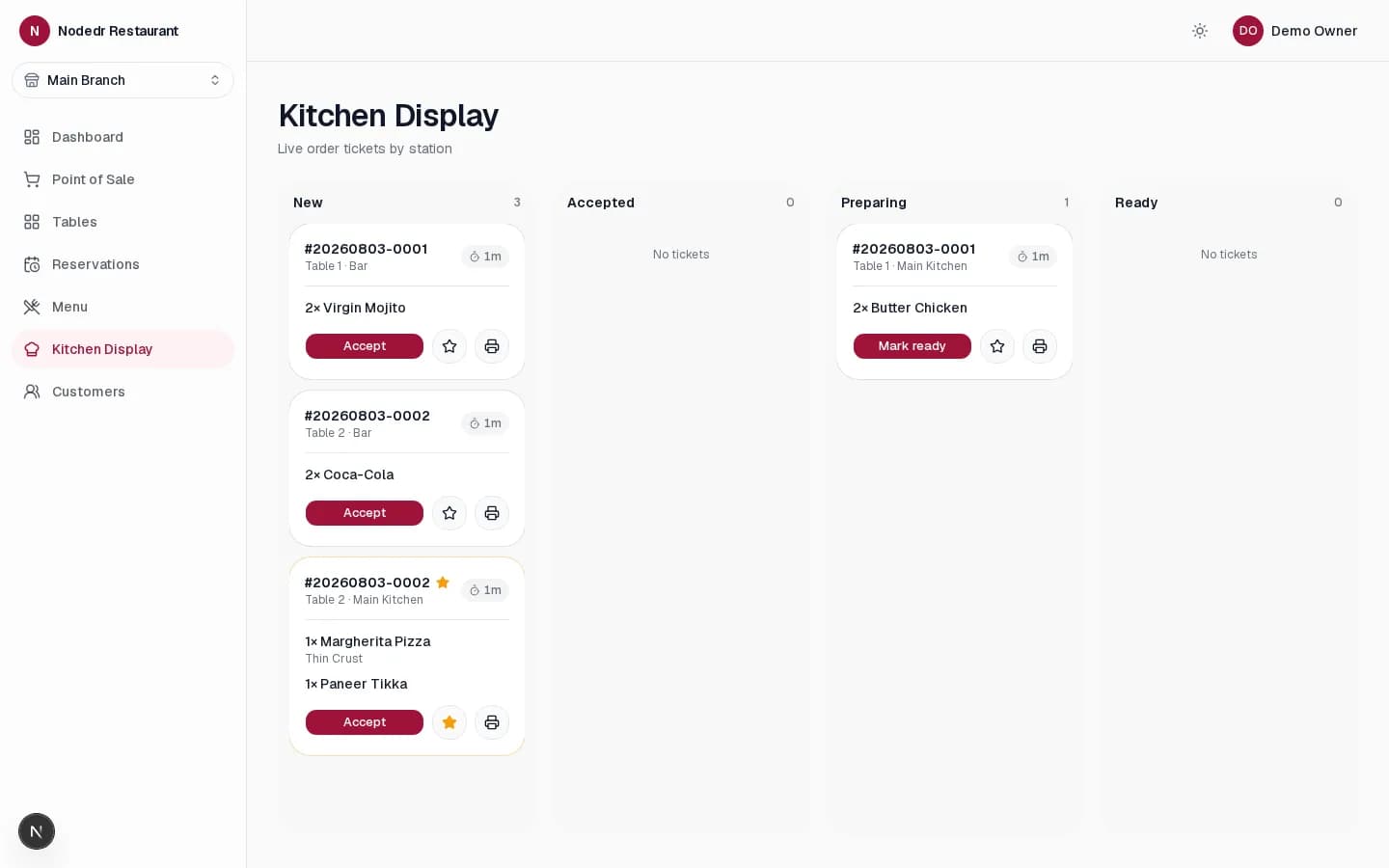
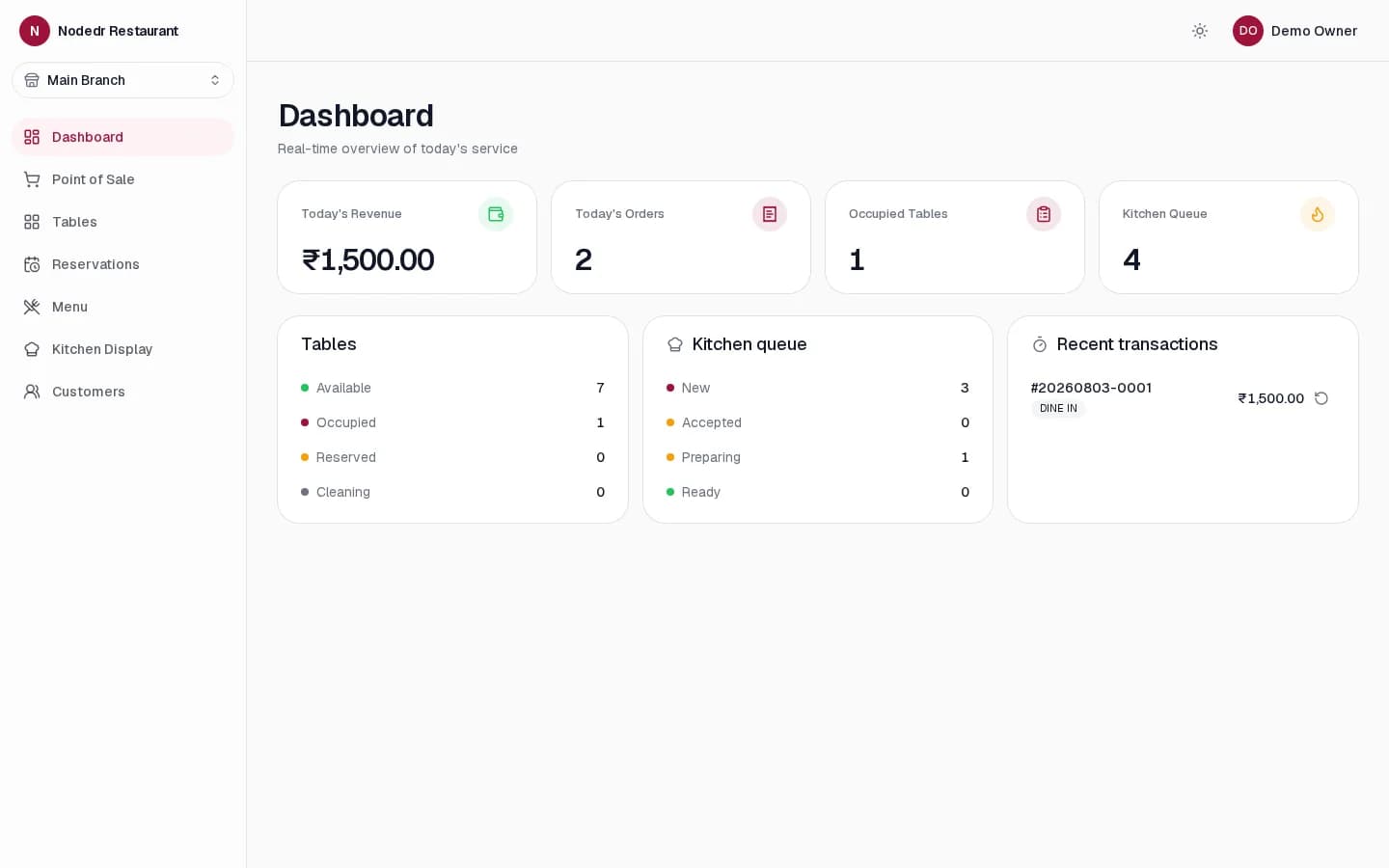
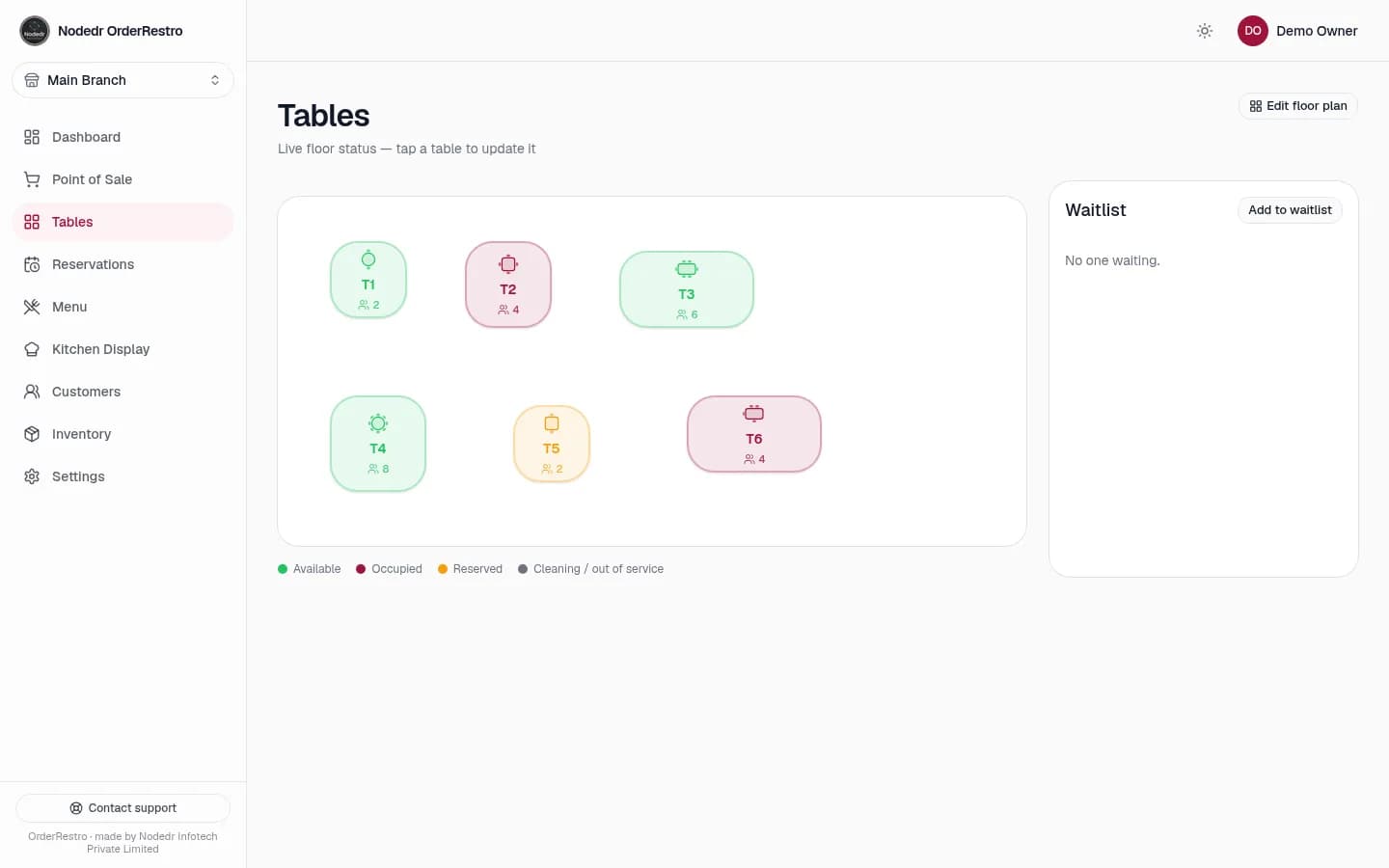
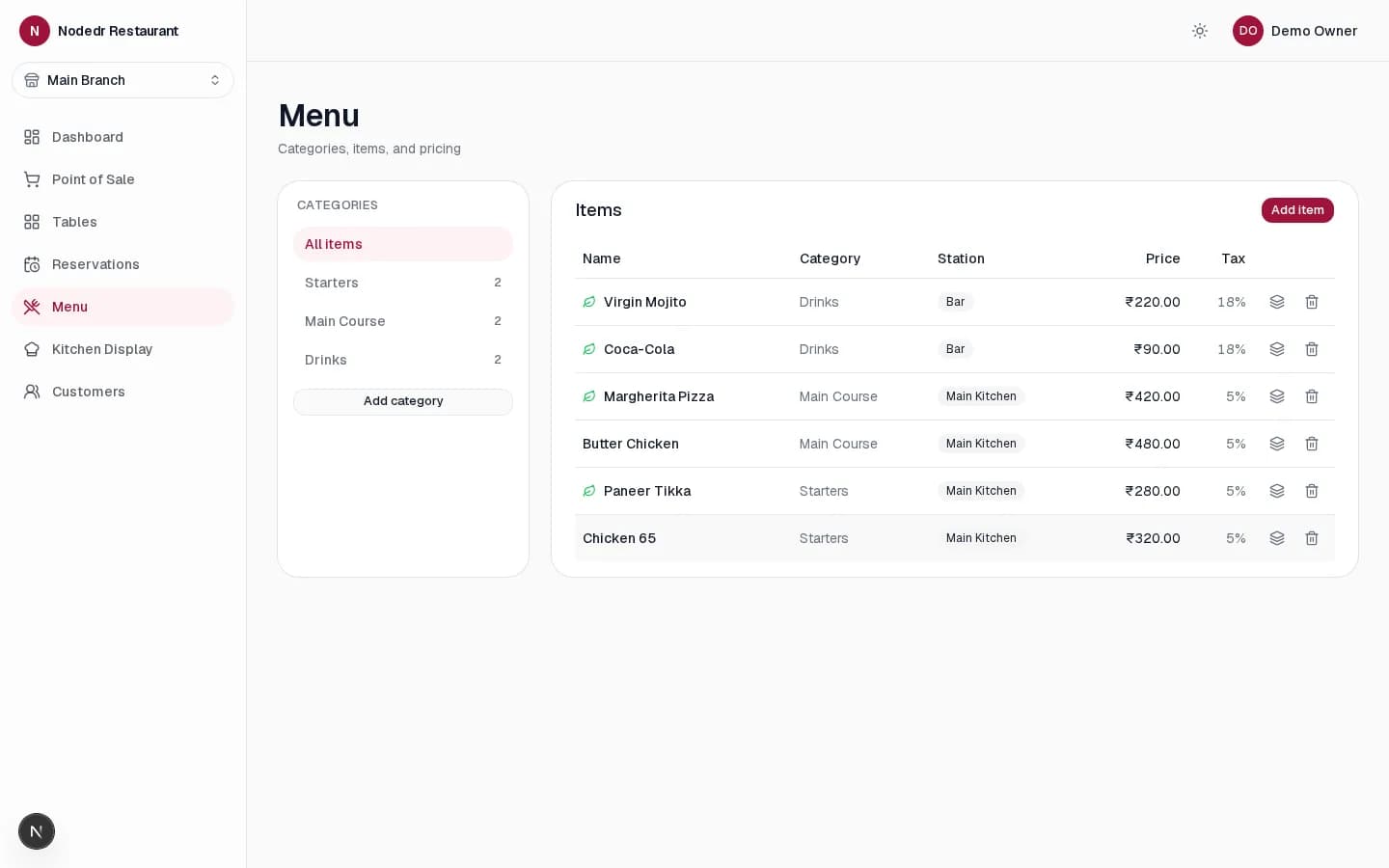
An order is taken with modifiers, routed to the kitchen display by station, and its status changes push back to the floor. Tables, reservations with a waitlist, QR table ordering, loyalty points, gift cards and combo meals all hang off the same order model.
Engineering challenge
Three kinds of screen need the same live state: the till, the kitchen display and the table map. Polling would have been simple, but a kitchen ticket that appears twenty seconds late is a failure the user can feel.
Architecture
A pnpm and Turborepo monorepo with a NestJS backend and a Next.js App Router frontend. NestJS was the one deliberate departure from the plain Express used in Nodedr POS: twenty product domains that must be independently addable and permission-gated need real module boundaries and dependency injection, and those would otherwise be hand-built.
Realtime uses a Socket.IO gateway with a namespace per concern for the kitchen, tables and orders.
Data model decisions
PostgreSQL through Prisma is the primary target. The original brief asked for SQLite for single-location installs. I chose PostgreSQL instead and wrote down why in the architecture document, because two database dialects for one product doubles the migration and testing surface.
Backend
Each domain, such as menu, inventory and kitchen display, is a self-contained module with its own controllers, services and validation. A documented REST API, webhooks and an MCP server expose the system to other software.
Frontend
Next.js with Tailwind, TanStack Query for optimistic updates, TanStack Table for large lists and a drag-and-drop floor designer. The point-of-sale screen is built for touch and speed. A thin Windows client wraps the web app for tills that are Windows machines.
Security
Every action is gated by a granular, individually toggleable permission, never a hard-coded role check. Sessions use an httpOnly cookie with PIN quick-switch for fast staff handoff on a shared till. TOTP is optional per user. All price, tax, discount and loyalty arithmetic runs on the server and the client is never trusted for money.
Infrastructure
Three containers: PostgreSQL, API and web. The same compose file runs on a restaurant's LAN server, on a VPS, behind a tunnel, or as a CasaOS app. I documented a trap in the tunnel case: the session cookie must be marked Secure once traffic arrives over HTTPS, but a Secure cookie is silently dropped on a plain HTTP origin, which makes every login appear to succeed and then return Unauthorized.
Reliability considerations
The reliability target is that order-taking, billing, the kitchen display and printing continue with the WAN cable unplugged. That is a design constraint applied to every module, not a configuration option.
Difficult tradeoffs
Offline-first means the restaurant owns a server. That removes subscription dependency and also moves backups, updates and hardware failure onto the operator, which is a real cost for a small business.
What I personally worked on
Architecture, backend, web application, the permission model, deployment packaging and documentation. A recent round of work added the REST API reference, webhooks and an MCP tool surface.
Lessons learned
Reusing a proven pattern is worth more than reusing the code. I kept the lessons of the retail POS and rebuilt the domain model for a different business.
Technologies
- NestJS
- TypeScript
- Prisma
- PostgreSQL
- Next.js
- Socket.IO
- Docker
- pnpm
Screenshots
Captured from running instances.
OrderRestro: frequently asked questions
- What is OrderRestro?
- OrderRestro is a restaurant management system covering POS billing, table management, a kitchen display, reservations with a waitlist, QR table ordering, loyalty points, gift cards and combo meals.
- Does OrderRestro work without internet?
- Yes. The database, API and web application run on one machine on the restaurant's own network, so order-taking, billing, the kitchen display and printing continue with the internet cable unplugged.
- Is OrderRestro open source?
- Yes. It is published on GitHub under the AGPL-3.0 licence.
- How does the kitchen see new orders?
- A Socket.IO gateway pushes order and status changes to the till, the table map and the kitchen display in real time, split by station.
- How is it installed?
- Three containers (PostgreSQL, API and web) run from one compose file on a restaurant LAN server, a VPS, behind a tunnel, or as a CasaOS app.
Expertise this project shows
Related articles
- What changes when the internet is optional: notes from building OrderRestro
- Self-hosted restaurant POS with a kitchen display that keeps working offline: OrderRestro
- What is offline-first software? How it works and when to build it
- How to choose a POS system for a small business: a buyer's checklist
- Toast vs Square vs Clover: how to compare restaurant and retail POS systems
- Cloud POS vs on-premise POS: which is better for a shop or restaurant?
- What is forward deployed engineering? The job, the skills and how it differs from support
- A business day is not always a calendar date in the server's time zone
- WebSockets or server-sent events? Start with the direction of the conversation